
Whither the ‘Remote Speechwriter’
April 28, 2026
Since time out of mind, speechwriters have begged for access to their speakers. Now they want to work remote?
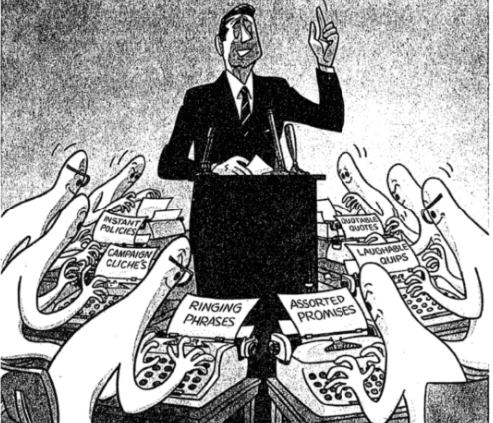
The Lorax spoke for the trees. I speak for the speechwriters. So I hate to side with anyone who refuses to hire one, for any reason.
But a speechwriter wrote me last week complaining that a Huge Corporation refuses to hire him because “they insist” he lives in the place where the headquarters are, “which won’t work for my wife and me.” He’s offered to spend three weeks per month working in an office the company has in his locale, and one week per month in the HQ town, “but no luck. Any advice?”
I had none, unless the CEO was going to be giving speeches quoting Alexis de Tocqueville on topics like the importance of civic organizations and the virtues of capitalism.
Sorry, but outside of politics, there is no such thing as pure speechwriter anymore. Thus, a tagline we permanently attached to the PSA logo several years ago, broadening the speechwriting assignment to “communicators who help leaders lead.”
How in the world are you supposed to help a leader lead in one city, while phoning it in from another? How exquisite a writer, how omniscient a communication counselor would you have to be to beat out, in a job competition, someone who was willing to be there for the boss, in the moment, in the rhythm of the business, whenever a thing went down, or either of you had a good idea, day in and day out, in the belly of the corporate culture?
I used to argue that communicators ought to have offices with doors and a permission to hole up occasionally to think hard and write something big. And I still would defend that—just as I recommend the use of independent speechwriters to get a fresh take on a weary topic or a thought leadership moon shot for a big platform.
But generally, in-house exec comms is no longer a place for literary dilettantes.
I replied: “Honestly, I agree they should have someone in [the HQ town). I don’t think exec comms, for a leaders of a company that really believes in it as I think Huge Corporation does, can be done remotely, very well.”
Then, I posted the above screed on speechwriting’s social media circles, and gathered responses.
“I think you delivered a hard home truth to our speechwriting colleague,” wrote Lech Mintowt-Czyz, a longtime corporate speechwriter who now works as an independent. “It is not at all unreasonable for a company to expect an exec comms lead to be physically present and, indeed, it is somewhat deluded (or even suicidal) for an exec comms professional to expect to be able to succeed in a role without being present. In saying ‘no’ the company has done both sides a favor. In my view this person either needs to have a tough conversation with their family about moving, find a company that will employ them locally or have a tough conversation with themselves about whether an in-house role is truly suited to their (and their family’s) needs. There’s always freelance …”
Veteran speechwriter Jeff Opperman agreed with me too.
Any speechwriter who thinks he or she can do the job remotely is more interested in communicating what he or she thinks about the topic rather than what the speaker needs to say. A great speech needs input—lots and lots of input—and you can’t get input relying only on Zoom calls, emails, and internet research. Some of the best input on speeches I ever received were in those accidental moments when I bumped into someone in the hallway, or before a meeting on another subject started because someone else was running late. And let’s not forget the act of finding the speaker’s voice. That happens by listening to conversations; both conversations that include you and those that don’t. Once the speechwriter has a track record of success and trusting, successful relationships with the speaker and others in the organization that provide input, yes, working remotely is possible. It takes at least a couple of years to build those relationships, so in the meantime the speechwriter should plan on being in the office.
Mintaro Oba, a highly decorated speechwriter and co-founder of Speechwriters of Color, disagreed:
I don’t think this is an issue of the distinction between speechwriting vs broader exec comms. It’s an issue of whether both leaders and executive communicators can adapt to an era where remote/flexible work is more sensible and feasible for more people. Executive comms people are going to have to put in more effort to maintain relationships, navigate bureaucracy, and get crucial info when they are working remotely, but it absolutely can be done. But the implication that people who’d like to work remotely are more in the category of “literary dilettantes” doesn’t feel quite right to me.
Independent speechwriter Alex Marklew came down on Oba’s side:
I’ve worked for a speaker who I interacted with all day, every day while sat directly outside his office and a speaker who I met literally twice in the space of 12 months (and one of them was at my leaving do). And of course everywhere between those two poles. Right now I’m part of a company with 11 offices spanning six time zones on four continents, writing for a CEO who could be in any of those offices on any given day and who I see in person at best a couple of times a month. In an ideal world every job would be like my first example but in an age where C-suite speakers are rarely sat in one office all day it makes little sense for their speechwriters to be tied to their desk.
Former President Clinton Chief Speechwriter David Kusnet agreed with me—
The more personal interaction between the speechwriter & the speaker—and people close to the speaker and/or familiar with the subject matter and the organization—the better.
—as did Steve Askin, who wrote speeches for the late Chicago Mayor Harold Washington.
I totally agree. More than any of the other kinds of writing I’ve been doing for the last 40 years, effective speech writing requires a deep understanding of the way your client speaks, thinks, moves, engages with an audience … After all these years, I can still see remember how Harold’s thoughtful gaze into the eyes of constituents shaped and changed on the fly exactly how he interacted with his audience.
And we’ll give the last word to one Charles Crawford, for reasons that will reveal themselves in his answer.
I applied to be the Comprehensive Nuclear Test-Ban Treaty Organization Executive Secretary’s speechwriter based in Vienna. I did an online test. They offered me the job. I decided that I could not face working overseas again. Why not work remotely? The amount of “live” contact involved in speechwriting is small anyway. CEOs are busy people. As my online test was so much more awesome than all the others, they redefined the post and I work from home. Any discussions with the Executive Secretary and his team can be done by Zoom. Result? Three Cicero Awards in the past two years including Grand Winner Of course each organization and each leader is different. But be reasonable. The great speeches need great ideas. These may come from chatting in the corporate corridors. They may come from strolling on a faraway beach. Chemistry does not need proximity.
Well, not the very last word. While I think every one of the above responses has merit, we began with a corporate exec comms example. In that milieu, where “great speeches” and “great ideas” are rarely called for and rarely delivered—this world is more about the expression of tone and culture, and it’s expressed less frequently in keynotes than in chummy fireside chats or employee town halls—I believe chemistry and proximity do generally trump the awesomeness that even the greatest speechwriter can get across in an online writing test. Or perhaps the answer to my question above, “How exquisite a writer … would you have to be, to beat out, in a job competition, someone who was willing to be there with the boss?” … is a writer as exquisite as Charles Crawford. —DM
RELATED

David Murray Editor & Publisher, Vital Speeches of the Day
David Murray Editor & Publisher, Vital Speeches of the Day
EVENTS
-
How to (Finally) Integrate AI Into Your Exec Comms Workflow
APR 3-4 -
AI for Leadership Communication – Custom Workshop
Get in touch! -
Speechwriting School
OCT 26 -
PSA World Conference
OCT 26 - 28