
This Is What Civic Communication Looks Like
March 20, 2026
At the City Club of Cleveland this month, a speaker called out a civic group for valuing "profit over people." The civic group answered back—during the Q&A.
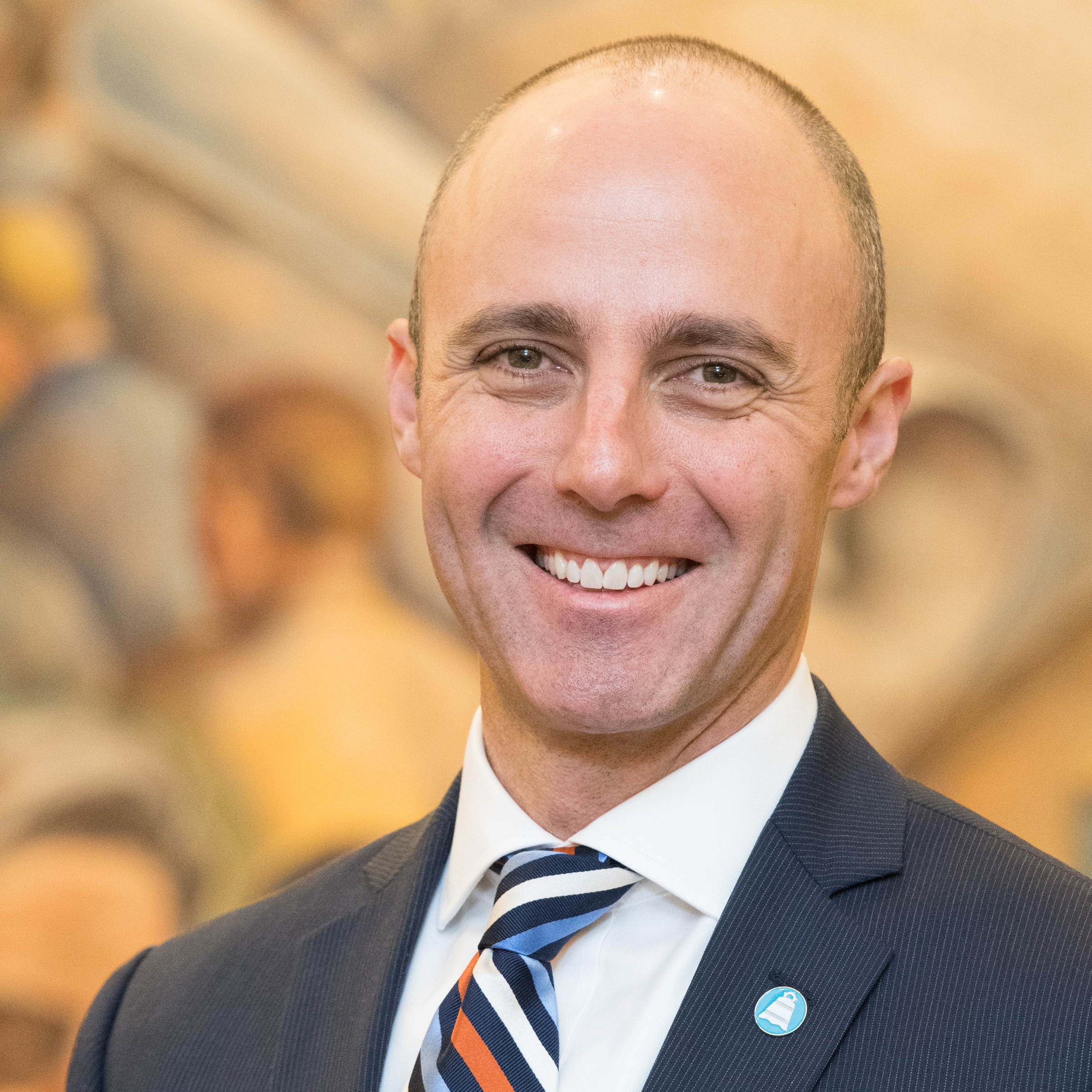
One of the best parts of participating in the City Club is being witness to moments of real, authentic civic work. There are moments at forums where you feel a shift, as if a fissure in the civic structures has just opened up and some new possibility is visible. Sometimes, it’s just a vibe in the room that you feel when you walk in and is still there an hour after the forum has ended as leaders linger, discussing what they just heard and what they might want to do about it. And other times, like Friday, March 6, it happens inside the 60 minutes of the forum, when a calling out is transformed into an opportunity.
Chris Knestrick is one of our community’s indefatigable champions for the unhoused. Quietly and determinedly, and with religious conviction, he advocates for the unsheltered and those living precariously close to the margins. On Friday, in the midst of his appearance on our stage representing the Northeast Ohio Coalition on the Homeless (NEOCH) as part of the Local Heroes series presented by our partners at Enbridge and Citizens, he shared a story filled with lessons about power imbalances, justice, and accountability. A transcript follows the video.
Unfortunately it’s just not in LA that so-called improvement districts punish homeless people. In January, weeks after we opened the seasonal shelter on East 19th in the middle of the coldest month of the year, we got an email from the Superior Arts District claiming, a parcel level analysis by the New York City Independent Budget Office found that residential properties within 500 ft of emergency shelters sold for approximately 6 to 7% less. In their email they demanded the city shut us down and I was pissed, but I immediately saw the silver lining.
That same email also said that to lease vacant units that are located close to shelter, landlords must often reduce rents. So I was glad that NEOCH’s new building was helping making downtown just a little bit more affordable for just about everyone.
By February, during the longest prolonged cold snap in over 100 years, the Superior Arts District demanded we meet with them in a room in City Hall with the biggest table I’ve probably ever seen. The board of the District side by side with Downtown Cleveland Incorporated, and their fancy looking attorney walks in.
As organizations so concerned about people living on the streets, I explained to them that the guests now live in shelter were previously sleeping in the improvement district. Providing them a safe space indoors sounds like an improvement to me.
They didn’t seem to care.
I asked if there was any issues with our guests. There didn’t seem to be any.
Nonetheless, they demanded that everyone get kicked out onto the freezing streets that night.
Thankfully we have a renovated building that meets zoning requirements and occupancy requirements. There’s not much that can be done to shut us down, but I like to think that maybe they heard the rumors of my wrestling matches in LA.
Seriously though, housing justice calls us to build systems that make life more dignified for people. Too often our systems enable the opposite hotels refusing to allow people experiencing homelessness to stay there, NIMBY neighbors in Ohio City preventing youth drop-in centers, and this most recent attempt to shut down the first permanent seasonal shelter in Cleveland.
The work of housing justice does not give one inch to those who value profit over people.
—–
Our speakers seldom call out organizations or individuals by name in that way. The audience knew exactly who Knestrick was talking about, and the kind of structural power that was being brought to bear on NEOCH. This is what public accountability looks like. It was a powerful moment, a David and Goliath narrative we could laugh along with, that might even inspire us to pitch in with some sort of contribution of time, energy, or money.
Only a few at the forum knew, though, that one of the other attendees of that meeting was also in the audience. But even those who knew he was there were probably not expecting Michael Deemer to step to the microphone during the Q&A.
Michael Deemer: Good afternoon, Chris.
Chris Knestrick: How are you?
Deemer: Doing well. Michael Deemer from Downtown Cleveland Inc. and also the Superior Arts Improvement District
Knestrick: You wanna wrestle?
Deemer: I don’t, but I do want to agree with about 99% of what you had to say today. Certainly disappointed in the characterization of the positions that my organizations took relative to the seasonal shelter fully. Supportive of getting people out of the cold and into shelter, fully supportive of the mission to end unsheltered homelessness and overcome the barriers that you just alluded to in response to the previous question.
My question, for you today, and this is something I was hoping to talk with you over coffee about next week, but my question for you today is, in light of our, our shared goals and the fragmented system of services that we have across downtown, in the Campus District in particular, would you be willing to join our organizations in creating a comprehensive coordinated plan for how services are delivered across downtown, and would you join us in trying to find a permanent increased source of funding for A Home For Every Neighbor?
Knestrick: Yeah, absolutely. I mean, I thank you so much. I appreciate this question and I’m looking forward to coffee, and I think it’s important to understand that Cuyahoga County Office of Homeless Services has a plan to end unsheltered homelessness and that we are… however we’re coordinating services that it aligns with that plan in our community because I think we put a lot of work in that plan.
Our outreach team put a lot, a lot of people with lived experience put a lot of work into that plan to really give us the pathway, and part of that plan was to, you know, build.
Have a permanent seasonal shelter and also a navigation center so what I’m thankful for is that we are in the process and have the funding to move that space into a full-time navigation center for our community, and so it’s gonna be imperative that we coordinate services and it’s, I think we align on the fact that neither of us wanna have people on the streets in our community, right?
And how do we have that goal be our guidestone from which we coordinate services in our community.
And that we can work together on that goal and I’m very hopeful for that and NEOCH, a lot of NEOCH work is already coordinating those services, particularly for unsheltered people so how do we make sure that we’re, in line with what you all want and what we want?
I think for us it’s that we need to prioritize people all the time in their greatest time of need, and that is the most important thing that we need to do and that, and I mean 100% we are, you know, out there working to make sure that, the home for every neighbor is adequately funded and continues to get funded in our community because we believe that it is a program that is working to solve homelessness, in our community.
—–
This is also what public accountability looks like. It is the courage of responding to the call out with an acknowledgement of its justness and an invitation to collaborate. It is standing in front of a full room of people who know your name and allowing them to know your heart. It’s also a commitment to do some exceptionally challenging work.
Both Knestrick and Deemer deserve our recognition and support. This wasn’t vague civic hand waving, hoping the community moves on to another deeply pressing issue. At least I hope it wasn’t. I hope it was a promise to keep moving good work forward to ensure that every neighbor indeed does have a home. And I believe it was also an invitation to the rest of us—to developers, lenders, housing advocates, interested members of this civic ecosystem—to figure out what part each of us can play.
There’s a forum in the future, where Knestrick and Deemer are on stage together with someone who will find a home thanks to them—they are telling the story that begins with this interaction. We’ll see you there.
RELATED
Exec Comms Worst-Case
Kirstie Foster President & Founder, Foster Modern PR, LLC
David Murray Executive Director, Executive Communication Council
EVENTS
-
AI for Speechwriting & Executive Communication – Custom Workshop
MAR 23 - 26 -
Speechwriting School Online
MAY - JUN 2026 -
Executive Communication Summit
JUN 23 - 25 -
Military Speechwriting Training Online
AUG 4 - 7