
Lincoln’s Ghost—and ‘Private Wordsmith’?
March 25, 2026
The author of "Lincoln's Speechwriter" claims John Hay provided President Lincoln's writings with "literary depth [and] classical knowledge of the ages."

Review of: Lincoln’s Speechwriter: John Hay and the Friendship That Inspired American Eloquence by Jan Cigliano Hartman (2026)
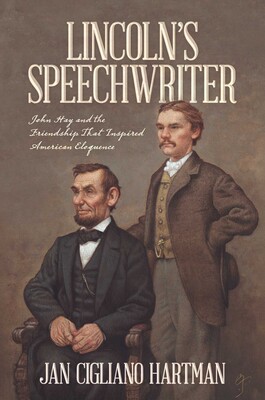
Did Abraham Lincoln—world-historical figure and considered by many one of the greatest American writers—quietly collaborate with a personal ghostwriter while in the White House? That is the key question raised and answered in the affirmative by this new study of Lincoln assistant John Hay (1838-1905) by historian Jan Cigliano Hartman.
As firmly as Hartman believes in the “Hay-as-ghost” thesis, she notes that the vast majority of Lincoln scholars have yet to be won over. Notes Hartman: “the Lincoln establishment [of academic historians] steadfastly maintains that the president did all his own writing.”
One exception to this involves Lincoln ally William Seward’s contribution to Lincoln’s first inaugural address. There is also the famous Bixby letter, which is believed by some to have been written by Hay, according to investigations by experts in the esoteric field of “forensic linguistics.”
Hartman also acknowledges that the reaction of every Lincoln scholar who reviewed her book in manuscript form was that to refer to Hay as Lincoln’s speechwriter is simply “bunk, unprovable, indefensible, wrong.”
That skepticism is understandable. The documentary record associated with Lincoln—the collective innumerable public and private materials, artifacts, and other items—has been studied far more closely, for much longer, than that of many other presidents. And that available documentary record does not directly substantiate Hay as having a ghostwriting role.
Before scrutinizing the basis for Hartman’s claim, let’s briefly examine her portrait of John Hay, the inferred ghostwriter. He was born in Indiana and raised in Illinois, in a much more prosperous atmosphere than Lincoln’s hardscrabble early life.
Hay’s early talent with words blossomed into his later intense study of poetry and literature, not only in English but also in German, French, and Spanish—plus Latin and Greek. (Lincoln in contrast, as Hartman reminds us, “had a year or so of formal schooling, scattered in a month here and a couple of months there.”)
After completing studies at Brown University in Rhode Island, Hay was drawn to Lincoln’s 1860 presidential campaign. Following Lincoln’s victory, Hay would travel to Washington in 1861 to begin working in the new administration. This included helping handle the voluminous presidential correspondence that daily flooded over Lincoln’s desk.
Hay’s work on Lincoln’s behalf included placing, over the course of the Civil War, a plethora of anonymous articles in various American newspapers, trying to rally Northern public opinion to Lincoln’s goals. The idea of Hay as a ghostwriter to Lincoln is contested, but there are virtually no doubts about the duration or intensity of Hay’s press-related activities on Lincoln’s behalf.
A trusted aide and confidant, Hay remained at Lincoln’s side up until the president’s demise following his fateful visit to Ford’s Theatre. Hay’s post-Lincoln career saw him continue his involvement in national politics, including as a diplomat.
Hartman believes that, soon after Hay and Lincoln initially met in 1859, the future president sized up Hay as a worthy potential collaborator; and after Lincoln purportedly tapped Hay to edit his Cooper Union remarks of 1860, the deal was sealed. The two men began a close but quiet oratorical collaboration, in which Lincoln could lean on Hay’s formal training to transform “his [that is, Lincoln’s] ideas and principles into refined prose, turning sweeping visions and maxims into durable truths.”
Where Lincoln “lacked Hay’s literary intelligence born out of his college education,” Hay could cover that deficit, and provide “Lincoln literary depth, classical knowledge of the ages, and an absolute loyalty that no one in his inner circle equaled,” as Hartman puts it.
How does Hartman support her Hay-as-ghost claim? She begins with, as noted above, Lincoln’s appearance at Cooper Union, a pivotal moment in his career. In the words of Harold Holzer, prominent Lincoln scholar, it was at Cooper Union that Lincoln’s typical speaking style as a “frontier debater and chronic jokester” at the podium publicly shifted, thanks to the “new oratorical style” that the future president adopted for the occasion.
What was this new style? Per Hartman, it was characterized by Lincoln’s reliance on “refined literary devices [such as] alliteration, repetition, and parallel structure.” That is—it prominently featured the very things that Lincoln had had very little time to study formally; and which Hay had not only studied extensively, but had demonstrably mastered, as displayed in his unpublished poetry (which Hartman patiently dug out of the relevant archives).
Hartman looks at other speeches, such as the Gettysburg Address and the first and second Lincoln inaugurals, as also benefiting from the same Hays-ian rhetorical and poetic touches.
How convincing is Hartman’s argument? For this reviewer, the idea of Lincoln enlisting Hay to get the benefit of the latter’s formal literary/poetic studies is certainly plausible—and if true, does not diminish Lincoln’s stature by a single iota. Has it not been a definite pattern, going back to George Washington’s collaboration with Alexander Hamilton and James Madison, for busy presidents to recruit ghostwriters as key assistants?
John Hay’s inferred ghostwriting role could well be what the movie director John Ford called one of those “when the legend becomes fact, print the legend” situations. It’s not at all hard to imagine a loyal ghost writing himself out of the historical record, so to speak, because of a personal preference for the “legend” of Abraham Lincoln, the president with no ghostwriters lurking in his office closet, to prevail over any behind-the-scenes “facts.”
Other readers, demanding a higher standard of evidence than the book provides, will find Hartman’s book a curated pastiche of coincidences, inferences and supposition. This audience will most likely not be convinced by the author’s argument. (Perhaps further supportive evidence will come in the years ahead, as those masters of “forensic linguistics” harness the proliferation of AI-related tools and extend their comparative Lincoln/Hay studies beyond the Bixby letter.)
That said, the level of well-researched, well-presented detail in this book regarding both Lincoln and Hay, and the fascinating facts of their non-ghostwriting-related collaboration and warm friendship, make it easy to strongly recommend Lincoln’s Speechwriter as a worthwhile addition to one’s springtime or summertime reading list.
1
Leave a Reply
RELATED
A ‘Big Tent’ Approach to Making Speeches: A Collection of Jesse Jackson’s Speeches and Sermons
Neil Hrab Rhetoric Editor, Vital Speeches of the Day
Neil Hrab Rhetoric Editor, Vital Speeches of the Day
EVENTS
-
AI for Speechwriting & Executive Communication
MAR 23 - 26 -
Speechwriting School Online
MAY - JUN 2026 -
Executive Communication Summit
JUN 23 - 25 -
Military Speechwriting Training Online
AUG 4 - 7
Interesting analysis. I will say this, though: at least we can be fairly certain that Lincoln’s speeches were NOT written by A.I.