

It was close to Miller Time late last Friday afternoon when I stumbled across a LinkedIn post by veteran corporate communicator John Clemons that almost made me spit out my High Life.
“TAKE NOTE,” Clemons commanded. “CEOs prefer AI over Human Speechwriters.” That may read like some communicators’ clickbait, but Clemons is a credible messenger: an International Association of Business Communicators Fellow, and one of the best-networked communicators in all of corporate communications. Clemons and I have 102 mutual connections. So if Clemons is sharing it, lots of my connections are reading it, too.
I have 106 mutual connections with Ray Day, the 2025 Chair of the Public Relations Society of America. In a LinkedIn post of his own, Day shared the statistic that begat Clemons’ clarion call, from the newly released 5th Annual HarrisX & Ragan Survey of Communications Leaders.

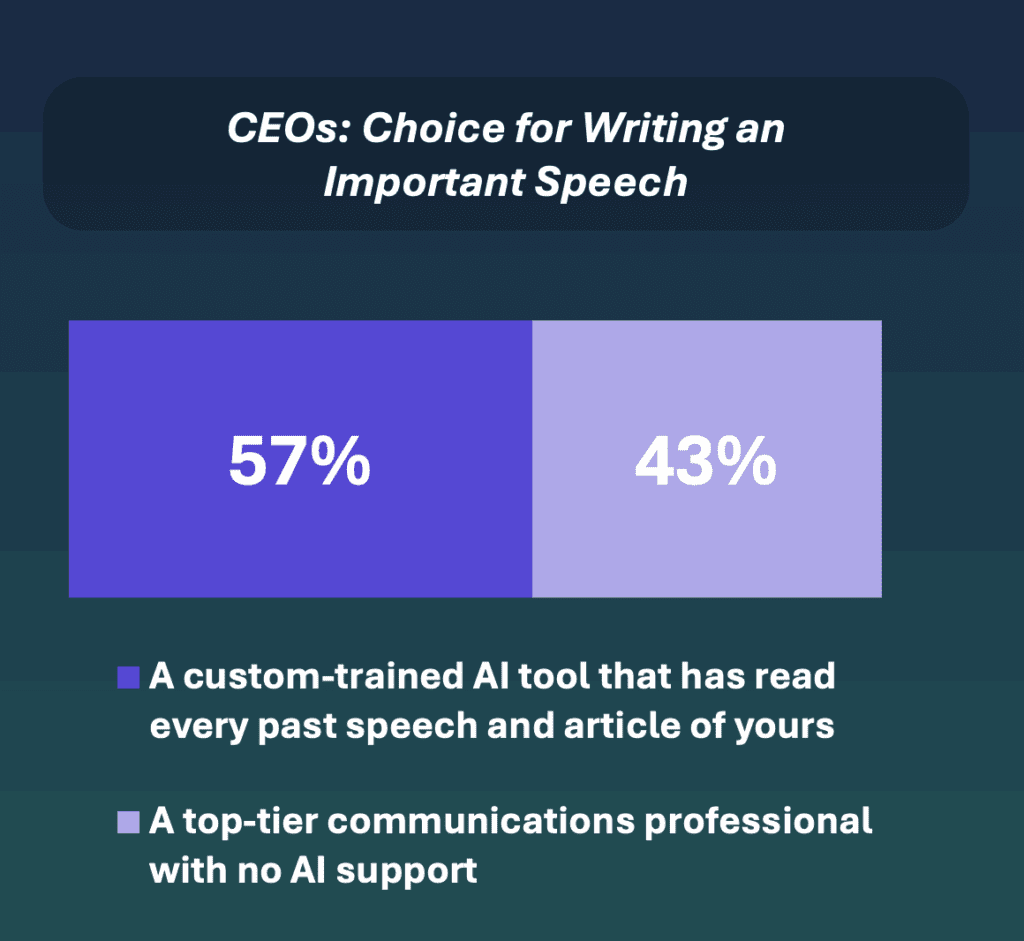
“Let that sink in,” wrote Day, vice chair at the global marketing firm Stagwell, who was previously CCO at IBM and a comms VP at Ford Motor Company. “We’re witnessing a fundamental shift in executive confidence that extends far beyond efficiency gains.”
Remarkably, this apparently atomic-bomb statistic wasn’t reverberating around the speechwriting or exec comms community. So I had a little time to reach out to the folks at Ragan Communications (where I got my start in the comms biz many years ago, and for which I wrote for more than 15 years).
I wrote:
Obviously your report on CEOs’ attitudes toward AI and speechwriting will be of great interest to our members and readers of our Executive Communication Report.
Before I share these survey results with them, I’m curious about the profile of the CEOs you surveyed. What sorts of companies do they lead? Are these Fortune 500 chiefs—the sort of folks who actually hire fulltime speechwriters and exec comms pros?
In my long experience, such folks are usually very difficult to survey—especially on subjects like speechwriting and exec comms. But maybe HarrisX has access.
Before I share these survey results with my audience, I’d very much like to get more information on who these folks are, and on your survey’s methodology.
In a follow-up email, I added: “To clarify my thought: Only if the CEOs you surveyed are predominantly Fortune 500, are their thoughts on replacing speechwriters with AI relevant—because those are the only corporate leaders who generally use human speechwriters in the first place. Whereas the CEO of a smaller entity, who doesn’t use a speechwriter—well, of course that CEO would be amenable to using AI for speechwriting help, because it will be better than nothing at all.”
Ragan referred me to Dom Bartkus, managing director at HarrisX (which is owned by Day’s firm, Stagwell).
Bartkus clarified that the question Ragan asked these CEOs was about a “top-tier communications professional,” not a speechwriter. “We went broader because as you say not every CEO has access to a professional speechwriter but all the CEOs in our sample work with comms professionals in-house and/or external agencies.”
As far as the types of CEOs HarrisX surveyed, Bartkus wrote, “The CEOs in our sample are a mix of large, medium and small organizations by revenue and number of employees.” In response to a follow-up email, he added, “Our sample of CEOs is aligned with previous waves of this study (it’s our 5th annual one) and we use various demographic and economic benchmarks to ensure the sample is not skewed. With that said, this is not a Fortune 500 CEO study, and it is, of course, possible that Fortune 500 CEOs might have a different view on this question.”
Probable, I’d say—for now anyway. Big-company CEOs are giving many fewer speeches lately, as they favor easier, less rigorous fireside chats. But in the rare instance they are going to give a major speech, they’re not likely to jet off to Davos or SXSW with a speech ghostwritten by ChatGPT. Those audiences expect a more deeply, finely tailored-to-the-speaker-and-audience-and-moment-in-time talk than that. And since those are the CEOs who employ speechwriters and exec comms pros in the first place, we can breathe again, for the moment.
“We’re at the precipice of something big,” said Diane Schwartz, CEO of Ragan Communications in the press release for the study, which you should download and read because it’s interesting in other ways. “Leaders have deep trust in their communications teams, but they’re also intrigued by the promise of AI. This is the moment for communicators to differentiate themselves from AI and emphasize the skills that technology can’t replace: strategy, creativity and empathy. By balancing these skills with an embrace of the efficiency AI can offer, comms leaders can increase their value.”
I guess we can agree with that, as far as it goes.
As for Ray Day, he wrote in another post last week, “I increasingly am called the ‘WHAT THE DATA SAY’ guy … As that data geek, I love the challenge of drilling down deep into data at increasingly detailed and granular levels to uncover hidden insights, identify trends and support decision-making.”
As long as we all remain as clear on what the data don’t say, as on what it does.